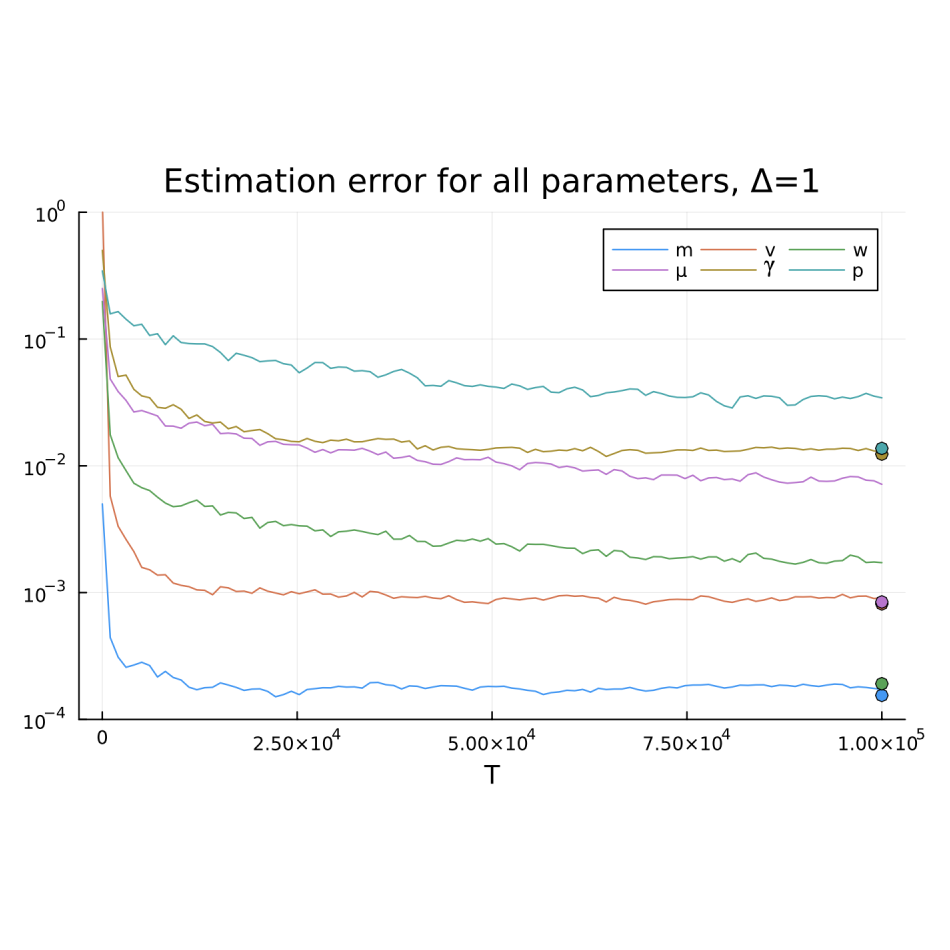
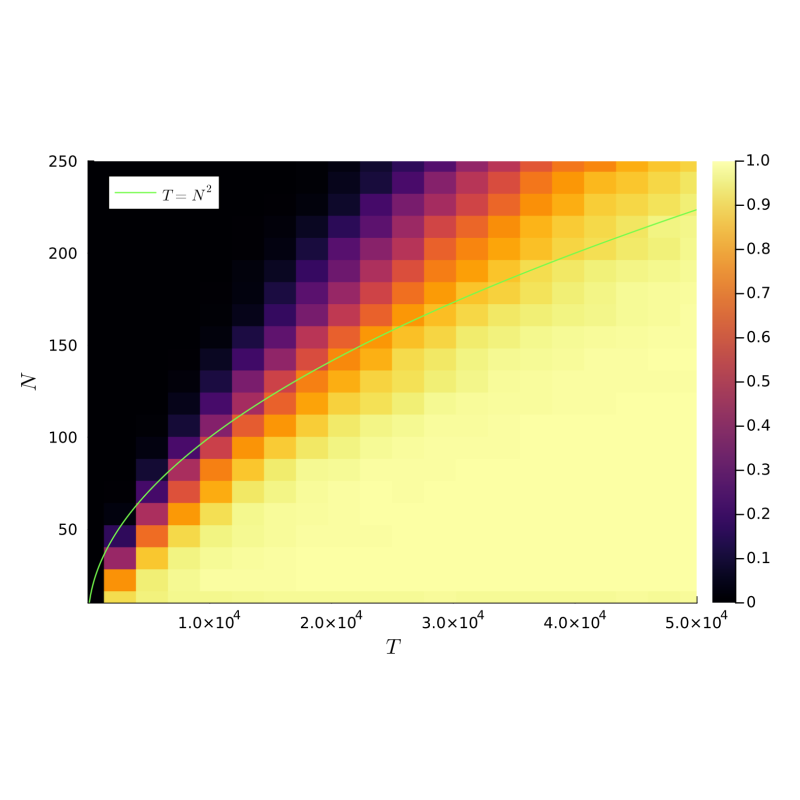
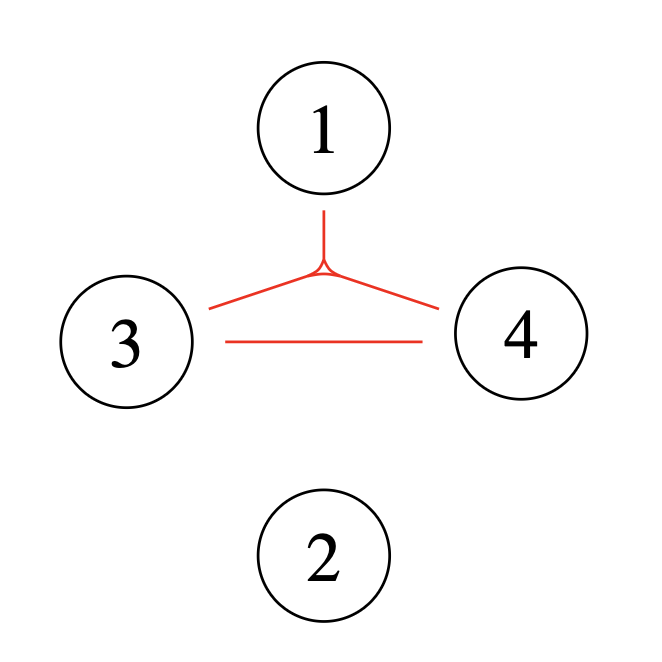
A huge number N of components are partitioned into two communities (excitatory and inhibitory). They are connected via a directed and weighted Erdös-Rényi random graph (DWER) with unknown parameter p. At each time unit, we observe the state of each component: either it sends some signal to its successors (in the directed graph) or remain silent otherwise. In this paper, we show that it is possible to infer the connectivity parameter p based only on the activity of the N components observed over T time units. We propose a simple algorithm for which the connectivity parameter p can be estimated with a specific rate which appears to be optimal in a simpler framework.
@article{chevallier2025inferring,author={Chevallier, Julien and L{\"o}cherbach, Eva and Ost, Guilherme},journal={Annals of Statistics (accepted)},title={Inferring the dependence graph density of binary graphical models in high dimension},year={2025},}
Preprint
Critical point processes obtained from a Gaussian random field with a view towards statistics
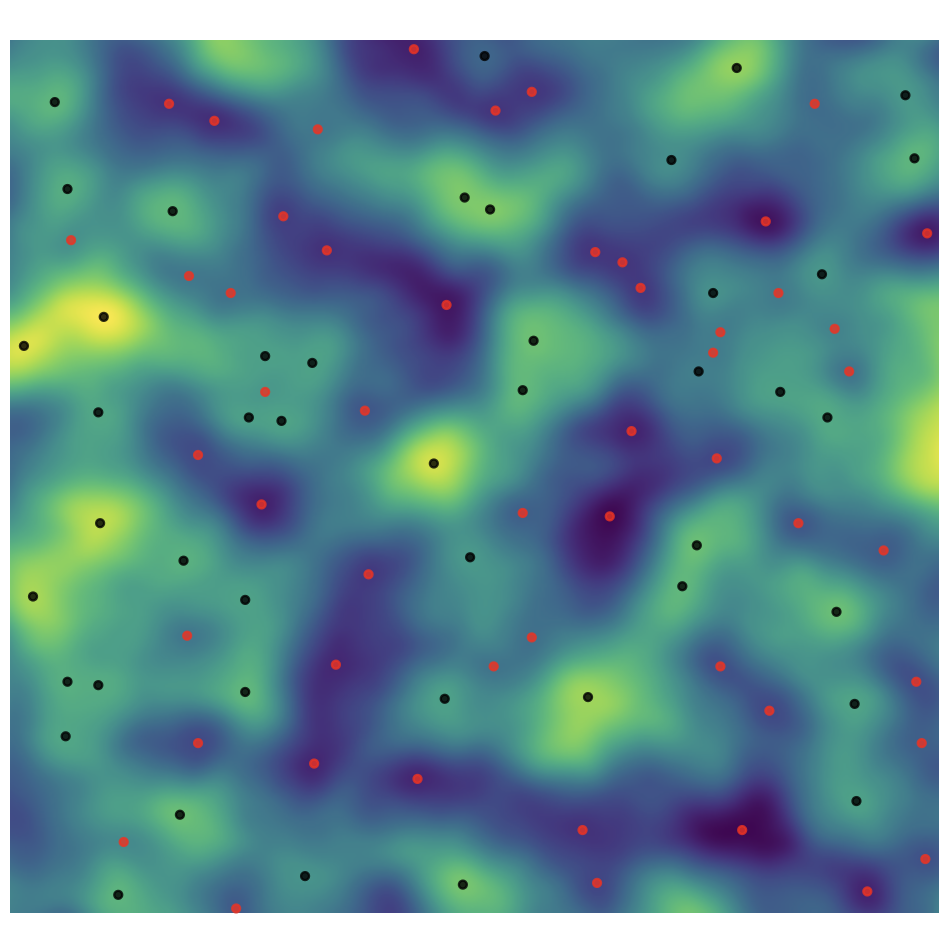
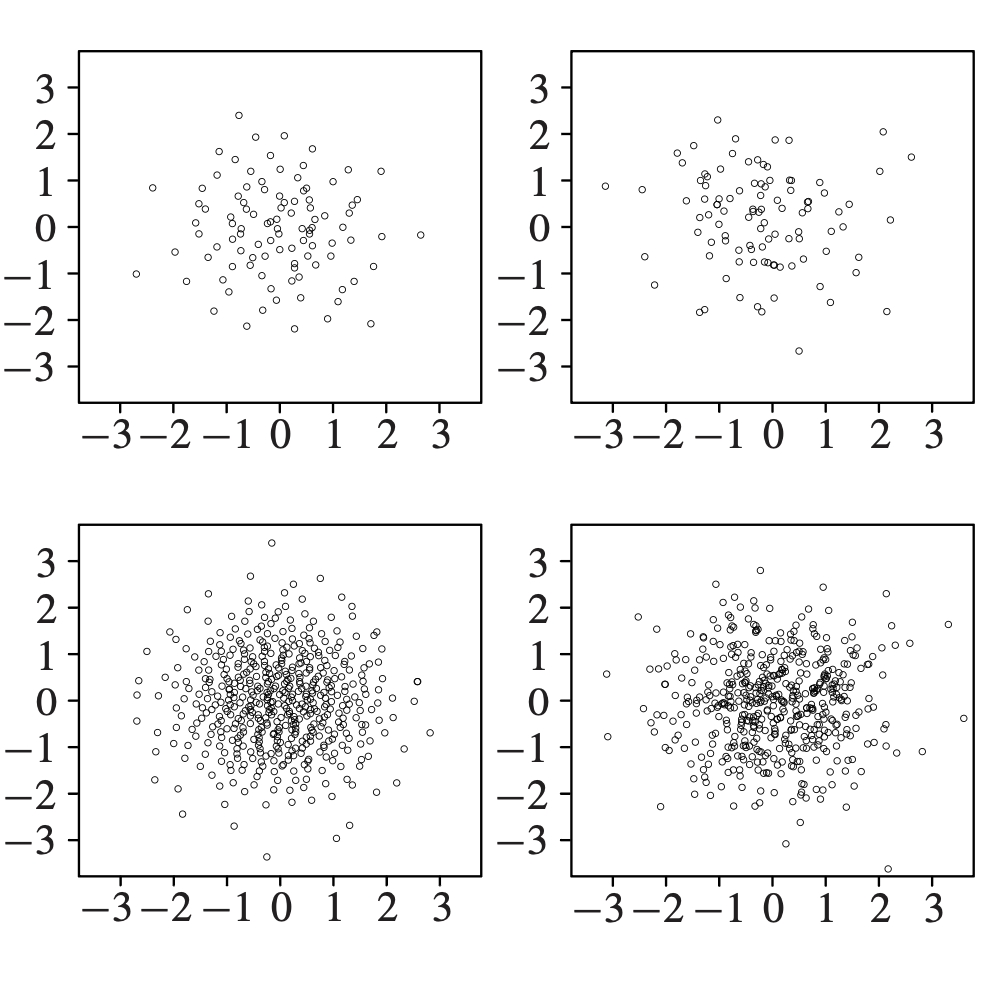
This paper establishes the theoretical foundation for statistical applications of an intriguing new type of spatial point processes called critical point processes. We provide explicit expressions for fundamental moment characteristics used in spatial point process statistics like the intensity parameter, the pair correlation function, and higher order intensity functions. The crucial dependence structure (attraction or repulsiveness) of a critical point process is discussed in depth. We propose simulation strategies based on spectral methods or smoothing of grid-based simulations and show that resulting approximate critical point process simulations asymptotically converge to the exact critical point process distribution. Finally, under the increasing domain framework, we obtain asymptotic results for linear and bilinear statistics of a critical point process. In particular, we obtain a multivariate central limit theorem for the intensity parameter estimate and a modified version of Ripley’s K-function.
@article{chevallier2025critical,author={Chevallier, Julien and Coeurjolly, Jean-Fran{\c{c}}ois and Waagepetersen, Rasmus},journal={arXiv},title={{Critical point processes obtained from a Gaussian random field with a view towards statistics}},year={2025},}
Habilitation Thesis
A journey in the fields of PDE, probabilities and statistics with point processes
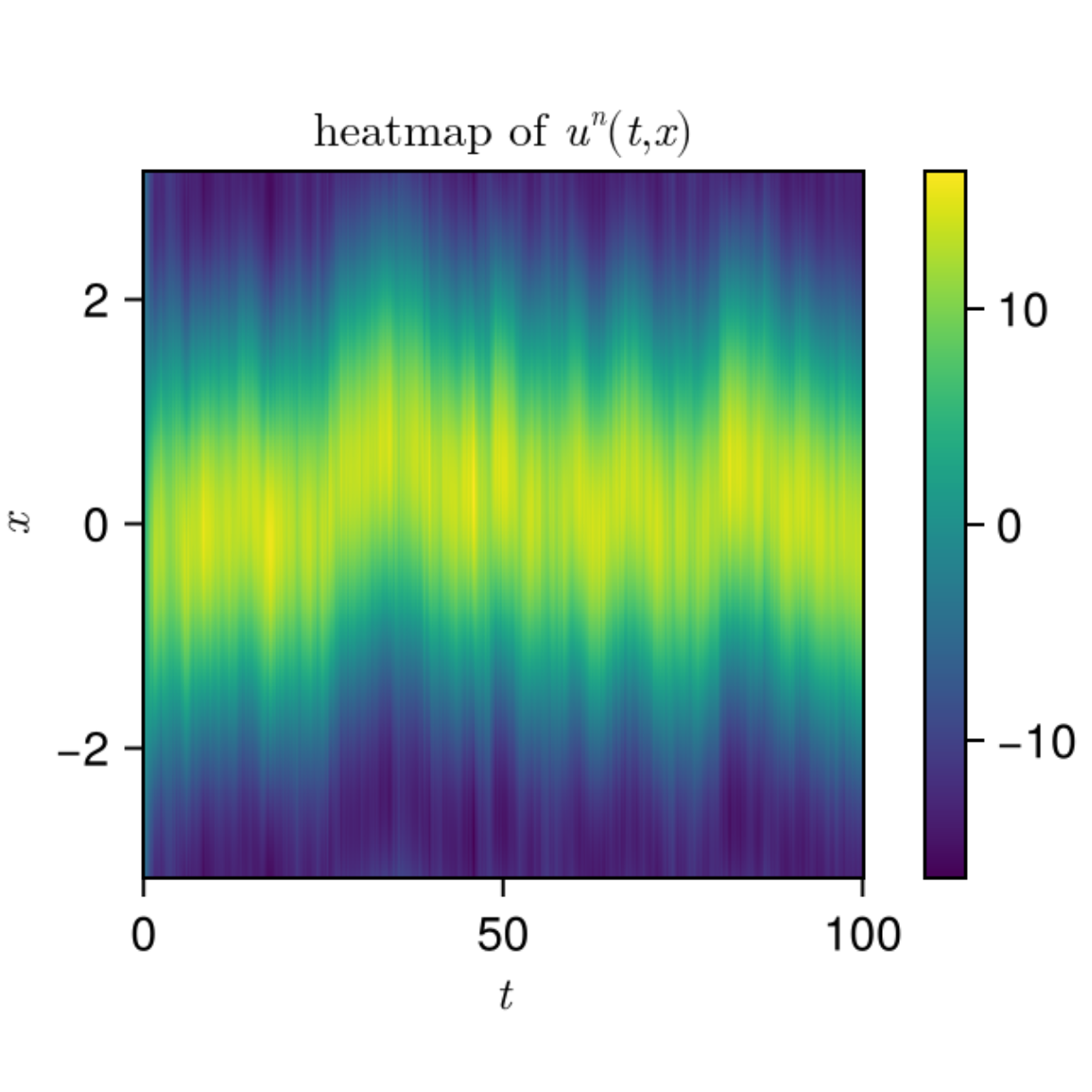
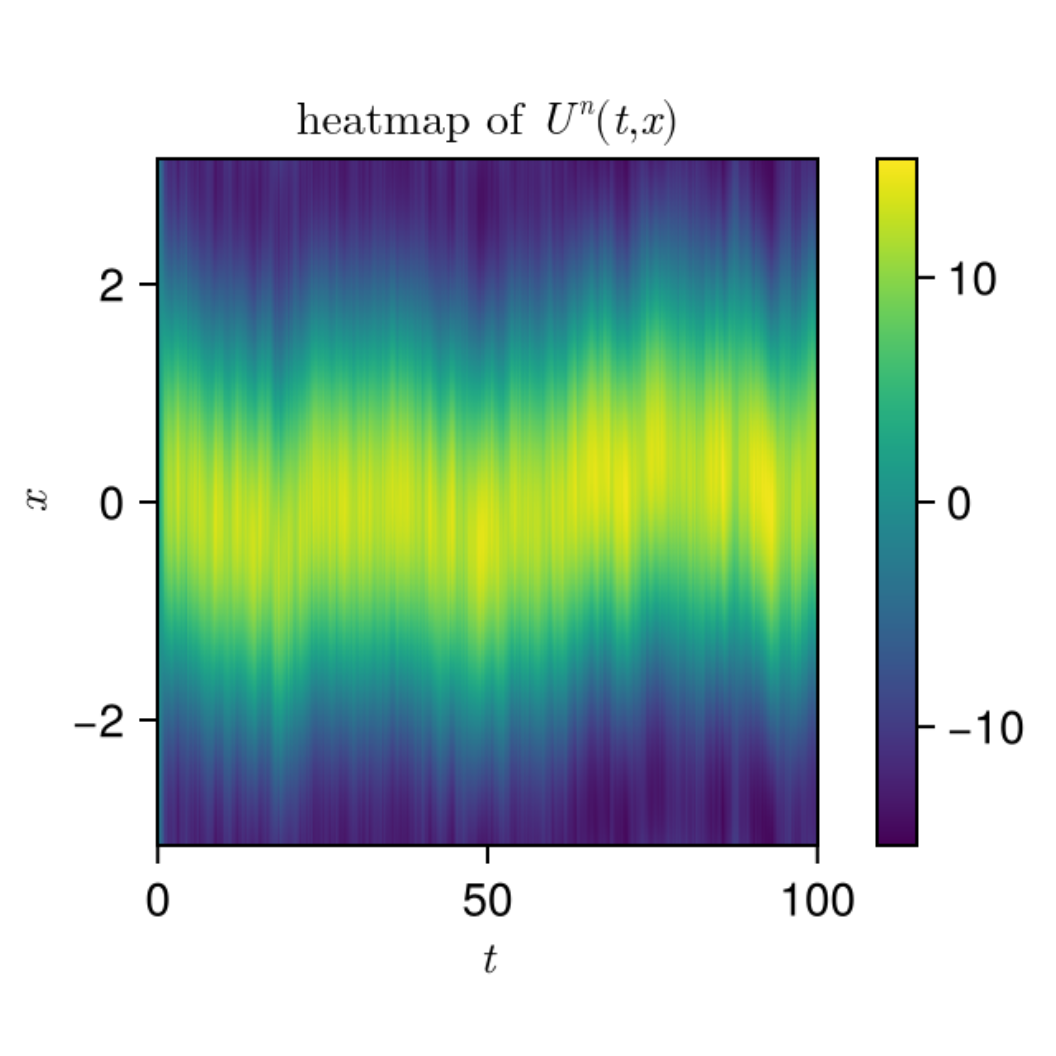
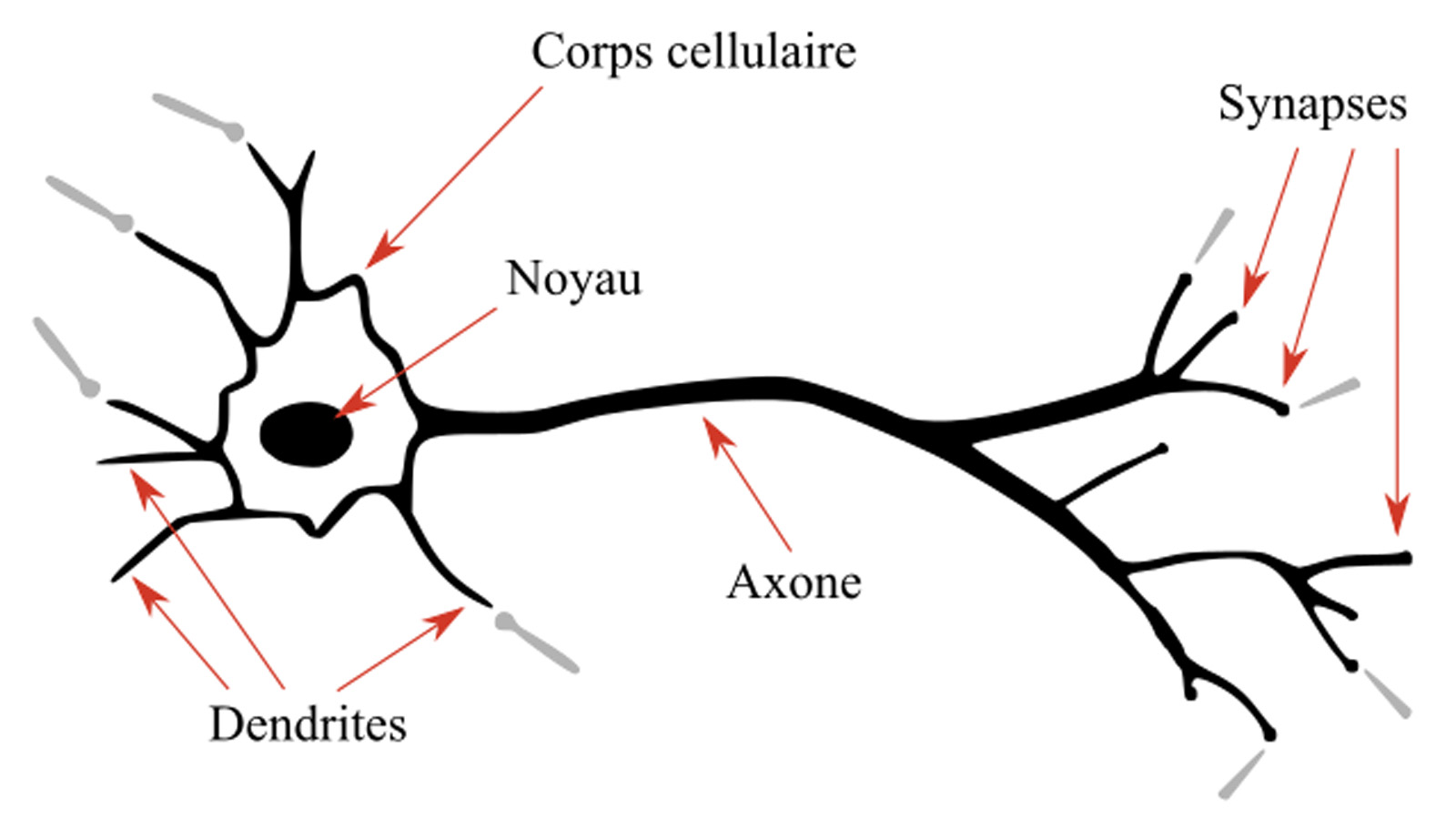
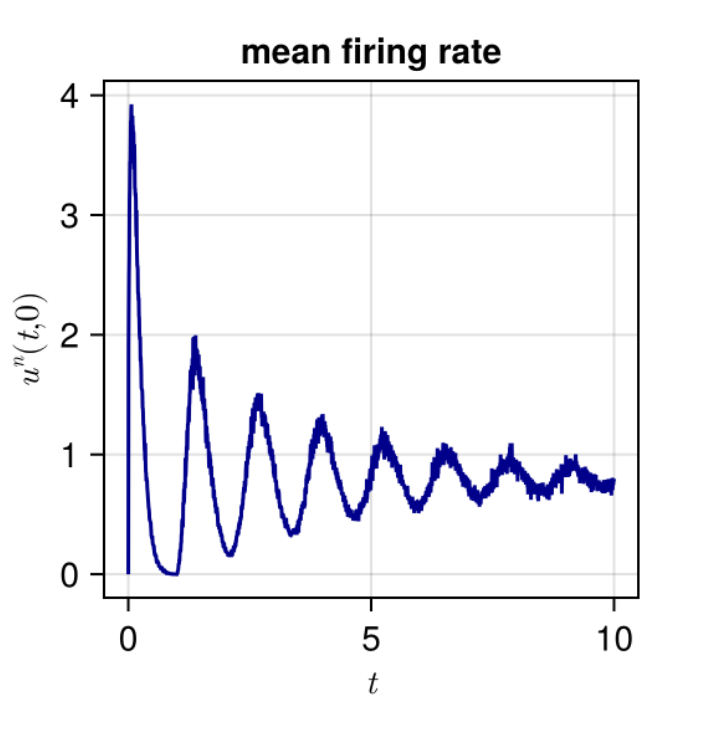
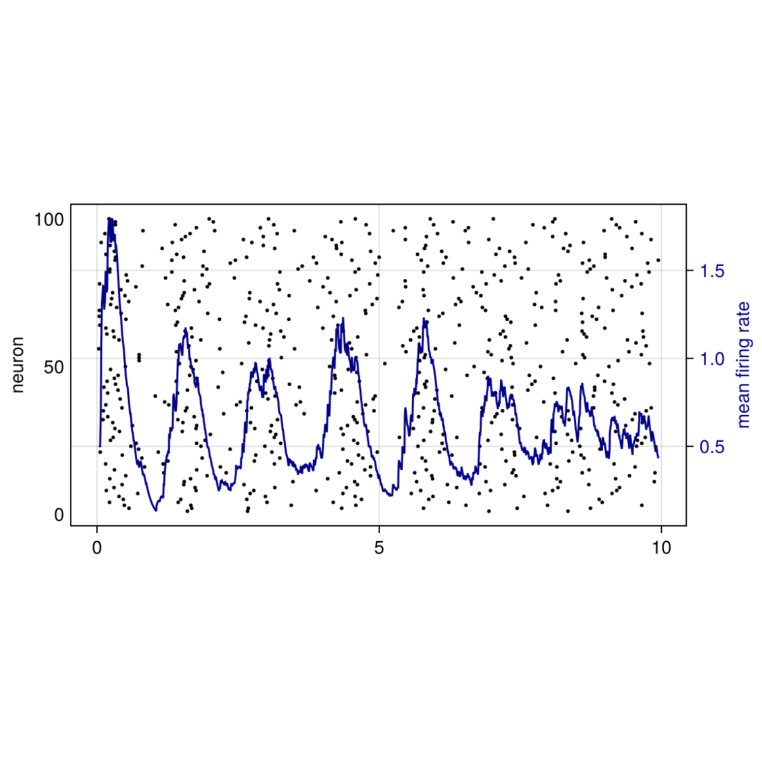
This manuscript focuses on biological neural networks and their modelling. It lies in between three domains of mathematics - the study of partial differential equations (PDE), probabilities and statistics - and deals with their application to neuroscience. On the one hand, the bridges between two neural network models, involving two different scales, are highlighted. At a microscopic scale, the electrical activity of each neuron is described by a temporal point process. At a larger scale, an age structured system of PDE gives the global activity. There are two ways to derive the macroscopic model (PDE system) starting from the microscopic one: by studying the mean dynamics of one typical neuron or by investigating the dynamics of a mean-field network of n neurons when n goes to infinity.
@phdthesis{chevallier2025journey,author={Chevallier, Julien},month=dec,school={{Universit{\'e} Grenoble Alpes}},title={{A journey in the fields of PDE, probabilities and statistics with point processes}},type={HDR},year={2025},}
2024
Preprint
Community detection for binary graphical models in high dimension
A huge number N of components are partitioned into two communities (excitatory and inhibitory). They are connected via a directed and weighted Erdös-Rényi random graph (DWER) with unknown parameter p. At each time unit, we observe the state of each component: either it sends some signal to its successors (in the directed graph) or remain silent otherwise. In this paper, we show that it is possible to find the communities based only on the activity of the N components observed over T time units. We propose a simple algorithm for which the probability of exact recovery converges to 1 for a specific asymptotic regime.
@article{chevallier2024community,author={Chevallier, Julien and Ost, Guilherme},journal={arXiv},title={Community detection for binary graphical models in high dimension},year={2024},}
2023
Preprint
Uniform in time modulus of continuity of Brownian motion
The main objective is to find a uniform (in time) control of the modulus of continuity of the Brownian motion in the spirit of what appears in (Kurtz, 1978). A stability inequality for diffusion processes is then derived and applied to two simple frameworks.
@article{chevallier2023uniform,author={Chevallier, Julien},journal={arXiv},title={{Uniform in time modulus of continuity of Brownian motion}},year={2023},}
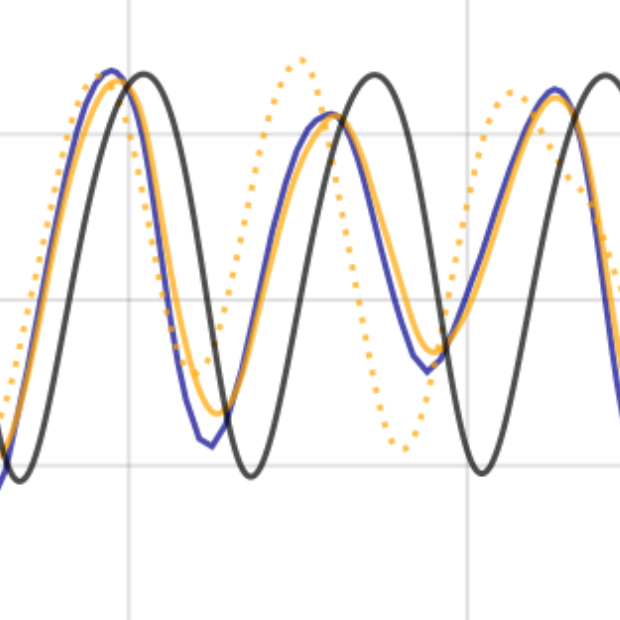
The oscillatory systems of interacting Hawkes processes with Erlang memory kernels introduced by Ditlevsen and Löcherbach (Stoch. Process. Appl., 2017) is studied. First, a strong diffusion approximation result is proved. Second, moment bounds for the resulting diffusion are derived. Third, approximation schemes for the diffusion, based on the numerical splitting approach, are proposed. These schemes are proved to converge with mean-square order 1 and to preserve the properties of the diffusion, in particular the hypoellipticity, the ergodicity, and the moment bounds. Finally, the PDMP and the diffusion are compared through numerical experiments, where the PDMP is simulated with an adapted thinning procedure.
@article{chevallier2021diffusion,author={Chevallier, Julien and Melnykova, Anna and Tubikanec, Irene},date-modified={2023-04-05 14:23:45 +0200},doi={10.1017/apr.2020.73},journal={Advances in Applied Probability},number={3},pages={716--756},publisher={Cambridge University Press},title={{Diffusion approximation of multi-class Hawkes processes: Theoretical and numerical analysis}},volume={53},year={2021},}
Preprint
Natural selection promotes the evolution of recombination 1: between the products of natural selection*
Philip J Gerrish, Benjamin Galeota-Sprung, Paul Sniegowski, and 3 more authors
Shuffling one’s genetic material with another individual seems a risky endeavor more likely to decrease than to increase offspring fitness. This intuitive argument is commonly employed to explain why the ubiquity of sex and recombination in nature is enigmatic. It is predicated on the notion that natural selection assembles selectively well-matched combinations of genes that recombination would break up resulting in low-fitness offspring - a notion often stated in the literature as a self-evident premise. We show however that, upon closer examination, this premise is flawed: we find to the contrary that natural selection in fact has an encompassing tendency to assemble selectively mismatched gene combinations; recombination breaks up these selectively mismatched combinations (on average), assembles selectively matched combinations, and should thus be favored. The new perspective our findings offer suggests that sex and recombination are not so enigmatic but are instead unavoidable byproducts of natural selection.Competing Interest StatementThe authors have declared no competing interest.
@article{gerrish2021natural,author={Gerrish, Philip J and Galeota-Sprung, Benjamin and Sniegowski, Paul and Colato, Alexandre and Chevallier, Julien and Ycart, Bernard},doi={10.1101/2021.06.07.447320},journal={bioRxiv},title={Natural selection promotes the evolution of recombination 1: between the products of natural selection*},year={2021},}
A functional central limit theorem is proved for mean-field interacting Hawkes processes with a spatial structure. It gives theoretical foundation for the stochastic Neural Field Equation.
@article{chevallier2020fluctuations,author={Chevallier, Julien and Ost, Guilherme},doi={https://doi.org/10.1016/j.spa.2020.03.015},issn={0304-4149},journal={Stochastic Processes and their Applications},number={9},pages={5510-5542},title={{Fluctuations for spatially extended Hawkes processes}},volume={130},year={2020},}
Preprint
Natural selection and the advantage of recombination
Philip J Gerrish, Benjamin Galeota-Sprung, Fernando Cordero, and 6 more authors
The ubiquity of sex and recombination in nature is widely viewed as enigmatic, despite an abundance of limited-scope explanations. Natural selection, it seems, should amplify well-matched combinations of genes. Recombination would break up these well-matched combinations and should thus be suppressed. We show, to the contrary, that on average: 1) natural selection amplifies poorly-matched gene combinations and 2) creates time-averaged negative associations in the process. Recombination breaks up these poorly-matched combinations, neutralizes the negative associations, and should thus be passively and universally favored.Competing Interest StatementThe authors have declared no competing interest.
@article{gerrish2020natural,author={Gerrish, Philip J and Galeota-Sprung, Benjamin and Cordero, Fernando and Sniegowski, Paul and Colato, Alexandre and Hengartner, Nicholas and Vejalla, Varun and Chevallier, Julien and Ycart, Bernard},doi={10.1101/2020.08.28.271486},journal={bioRxiv},title={Natural selection and the advantage of recombination},year={2020},}
A functional law of large numbers (propagation of chaos) is proved for mean-field interacting Hawkes processes with spatial structure. It gives theoretical foundation for the Neural Field Equation.
@article{chevallier2018mean,author={Chevallier, J. and Duarte, A. and L{\"o}cherbach, E. and Ost, G.},doi={https://doi.org/10.1016/j.spa.2018.02.007},journal={Stochastic Processes and their Applications},number={1},pages={1--27},title={{Mean field limits for nonlinear spatially extended Hawkes processes with exponential memory kernels}},volume={129},year={2019},}
A connected version of N neurons obeying the leaky integrate and fire model is studied. As a main feature, neurons interact with one another in a mean field instantaneous way driven by a random interaction graph. Due to the instantaneity of the interactions, singularities may emerge in a finite time. We collect several theoretical results on the behavior of the solution and provide an algorithm for simulating a network of this type with a possibly large value of N.
@article{grazieschi2019network,author={Grazieschi, Paolo and Leocata, Marta and Mascart, Cyrille and Chevallier, Julien and Delarue, Fran\c{c}ois and Tanr\'e, Etienne},doi={10.1051/proc/201965445},journal={ESAIM: ProcS},pages={445-475},title={Network of interacting neurons with random synaptic weights},url={https://doi.org/10.1051/proc/201965445},volume={65},year={2019},}
An elementary construction of a uniform decomposition of probability measures in dimension d ≥1 is provided. This decomposition is then used to give upper-bounds on the rate of convergence of the optimal uniform approximation error.
@article{chevallier2018uniform,author={Chevallier, Julien},doi={10.1017/jpr.2018.69},journal={Journal of Applied Probability},number={4},pages={1037--1045},publisher={Cambridge University Press},title={Uniform decomposition of probability measures: quantization, clustering and rate of convergence},volume={55},year={2018},}
2017
Lecture notes
Approximation par champ-moyen: le couplage à la Sznitman pour les nuls
The coupling method developed by Sznitman is illustrated on a very simple example and the main difficulties arising in more complex frameworks are pointed out. These are lectures notes accompanying the talk « Méthode d’approximation de champ-moyen : couplage à la Sznitman sur un exemple jouet. » performed on January 27 2017 at Young Statisticians and Probabilists 5th day.
@article{chevallier2017approximation,author={Chevallier, Julien},title={{Approximation par champ-moyen: le couplage {\`a} la Sznitman pour les nuls}},journal={Lecture notes},year={2017},}
A functional central limit theorem is proved for mean-field interacting age-dependent Hawkes processes. It gives theoretical foundation for the stochastic Refractory Density Equation.
@article{chevallier2017fluctuations,author={Chevallier, Julien},doi={10.1214/17-EJP63},issn={1083-6489},journal={Electronic Journal of Probability},pages={1-49},pno={42},title={{Fluctuations for mean-field interacting age-dependent Hawkes processes}},volume={22},year={2017},}
A functional law of large numbers (propagation of chaos) is proved for mean-field interacting age-dependent Hawkes processes. It gives theoretical foundation for the Refractory Density Equation.
@article{chevallier2017mean-field,author={Chevallier, Julien},doi={10.1016/j.spa.2017.02.012},journal={Stochastic Processes and their Applications},number={12},pages={3870-3912},publisher={Elsevier},title={{Mean-field limit of generalized Hawkes processes}},volume={127},year={2017},}
Stimulus sensitivity of the stationary Refractory Density Equation is studied. It appears that the maximal sensitivity is achieved in the sub-critical regime, yet almost critical for a range of biologically relevant parameters.
@article{chevallier2017stimulus,author={Chevallier, Julien},doi={10.1007/s10955-017-1948-y},journal={Journal of Statistical Physics},pages={800--808},publisher={Springer},title={Stimulus sensitivity of a spiking neural network model},volume={170},year={2017},}
Images des Maths
Nos neurones se synchronisent-ils ? (I)
Julien Chevallier, Marc Monticelli, and Patricia Reynaud-Bouret
This manuscript focuses on biological neural networks and their modelling. It lies in between three domains of mathematics - the study of partial differential equations (PDE), probabilities and statistics - and deals with their application to neuroscience. On the one hand, the bridges between two neural network models, involving two different scales, are highlighted. At a microscopic scale, the electrical activity of each neuron is described by a temporal point process. At a larger scale, an age structured system of PDE gives the global activity. There are two ways to derive the macroscopic model (PDE system) starting from the microscopic one: by studying the mean dynamics of one typical neuron or by investigating the dynamics of a mean-field network of n neurons when n goes to infinity.
@phdthesis{chevallier2016modelling,author={Chevallier, Julien},month=sep,school={{Universit{\'e} C{\^o}te d'Azur}},title={{Modelling large neural networks via {Hawkes} processes}},type={Theses},year={2016},}
An independence test between several neurons is constructed using the notion of coincidence (related to the Unitary Events method).
@article{chevallier2015detection,author={Chevallier, Julien and Lalo{\"e}, Thomas},doi={10.1002/bimj.201400235},issn={1521-4036},journal={Biometrical Journal},number={6},pages={1110--1130},title={Detection of dependence patterns with delay},volume={57},year={2015},}
The aim is to build a bridge between several point processes models (Poisson, Wold, Hawkes) that have been proved to statistically fit real spike trains data and an age-structured partial differential equation known as Refractory Density Equation and mathematically studied by Pakdaman, Perthame and Salort.
@article{chevallier2015microscopic,author={Chevallier, Julien and C{\'a}ceres, Mar{\'\i}a Jos{\'e} and Doumic, Marie and Reynaud-Bouret, Patricia},doi={10.1142/S021820251550058X},journal={Mathematical Models and Methods in Applied Sciences},number={14},pages={2669--2719},publisher={World Scientific},title={Microscopic approach of a time elapsed neural model},volume={25},year={2015},}