Spatio-temporal point processes for meteorological data (2022-2025) PI: Jean-François Coeurjolly
This project focuses on more or less realistic models for lightning strikes. One of the objectives is to implement statistical methods on very large (and very sparse) datasets of lightning strikes at the national level (or more reasonably at the level of the Alps) since 2012.
Related publications
2025
Preprint
Critical point processes obtained from a Gaussian random field with a view towards statistics
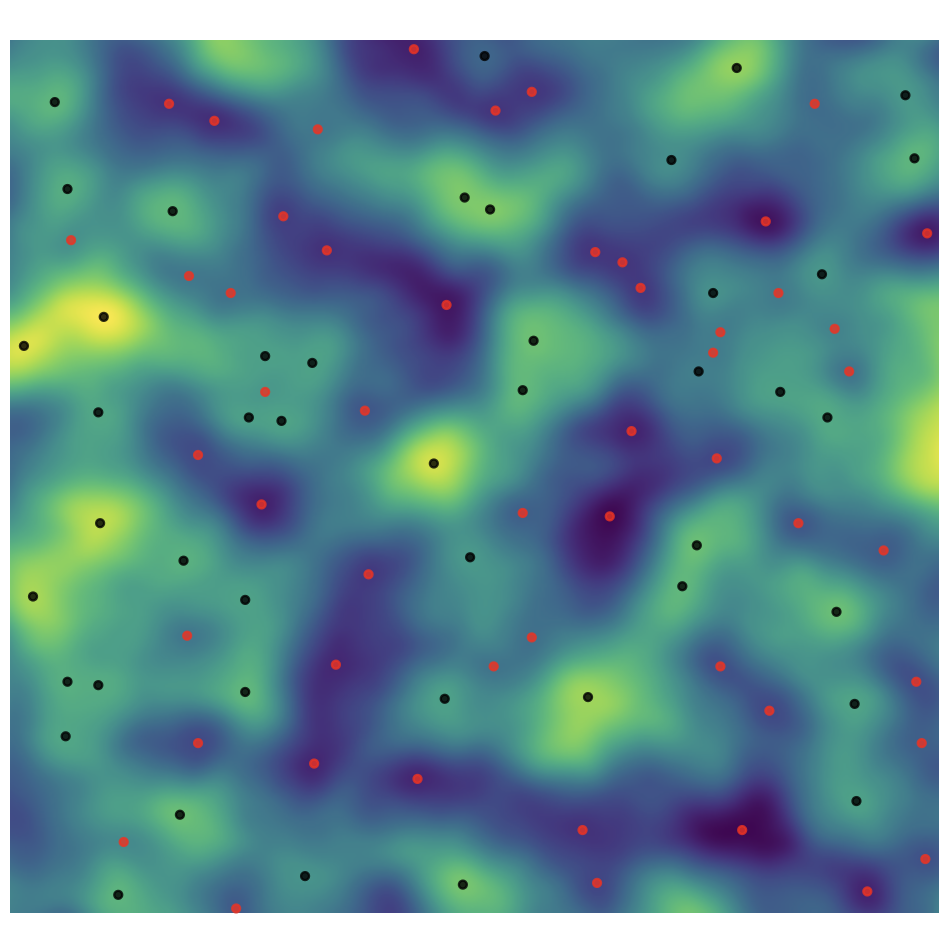
This paper establishes the theoretical foundation for statistical applications of an intriguing new type of spatial point processes called critical point processes. We provide explicit expressions for fundamental moment characteristics used in spatial point process statistics like the intensity parameter, the pair correlation function, and higher order intensity functions. The crucial dependence structure (attraction or repulsiveness) of a critical point process is discussed in depth. We propose simulation strategies based on spectral methods or smoothing of grid-based simulations and show that resulting approximate critical point process simulations asymptotically converge to the exact critical point process distribution. Finally, under the increasing domain framework, we obtain asymptotic results for linear and bilinear statistics of a critical point process. In particular, we obtain a multivariate central limit theorem for the intensity parameter estimate and a modified version of Ripley’s K-function.
@article{chevallier2025critical,author={Chevallier, Julien and Coeurjolly, Jean-Fran{\c{c}}ois and Waagepetersen, Rasmus},journal={arXiv},title={{Critical point processes obtained from a Gaussian random field with a view towards statistics}},year={2025},}