The aim of the ChaMaNe project is to create a research group in order to make significant advances in the field of mathematics derived from neuroscience. The mechanisms that govern brain dynamics are still far from being understood and modelling them is extremely complex. In particular, many scales coexist: from proteins and synapses to macroscopic brain areas and functions, from a few milliseconds of action potential to hours or years of synaptic plasticity and learning processes.
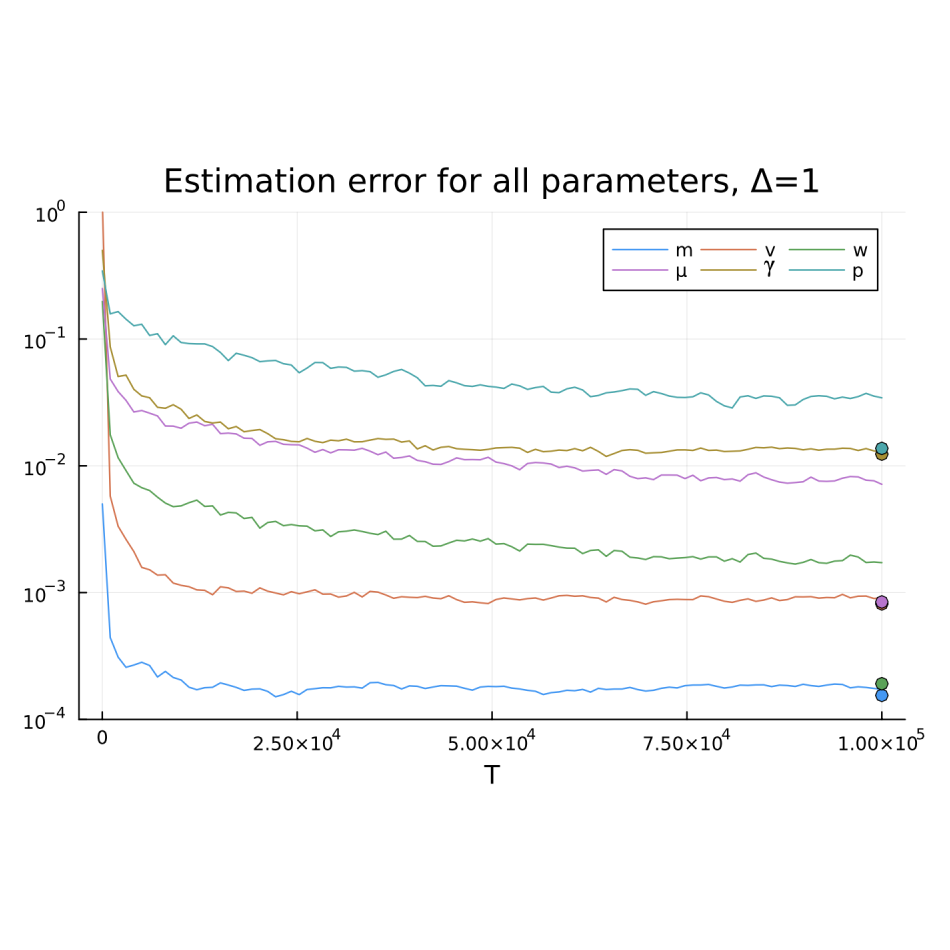
A huge number N of components are partitioned into two communities (excitatory and inhibitory). They are connected via a directed and weighted Erdös-Rényi random graph (DWER) with unknown parameter p. At each time unit, we observe the state of each component: either it sends some signal to its successors (in the directed graph) or remain silent otherwise. In this paper, we show that it is possible to infer the connectivity parameter p based only on the activity of the N components observed over T time units. We propose a simple algorithm for which the connectivity parameter p can be estimated with a specific rate which appears to be optimal in a simpler framework.
@article{chevallier2025inferring,author={Chevallier, Julien and L{\"o}cherbach, Eva and Ost, Guilherme},journal={Annals of Statistics (accepted)},title={Inferring the dependence graph density of binary graphical models in high dimension},year={2025},}
2024
Preprint
Community detection for binary graphical models in high dimension
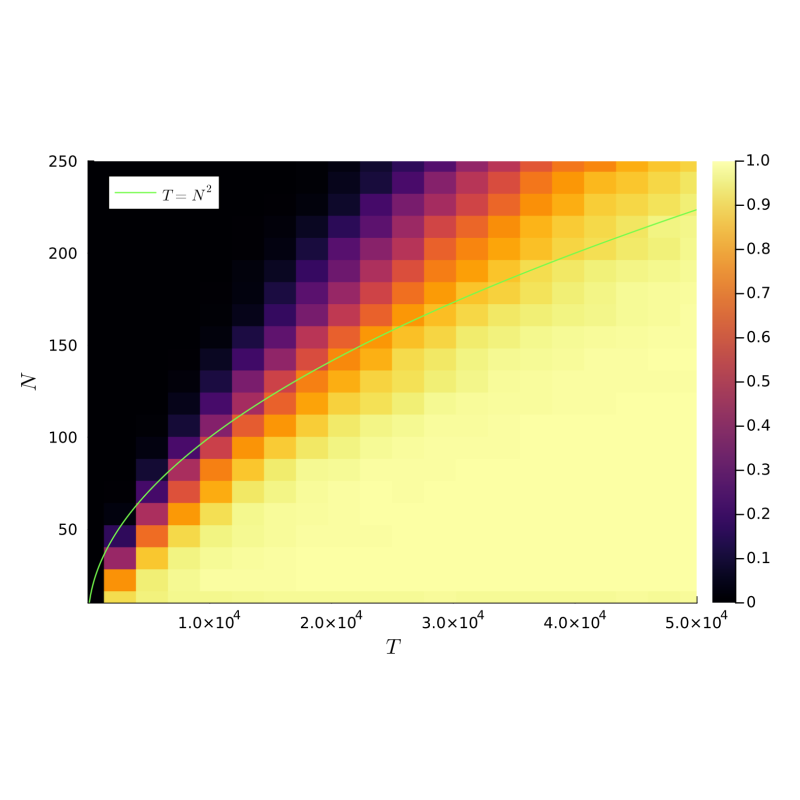
A huge number N of components are partitioned into two communities (excitatory and inhibitory). They are connected via a directed and weighted Erdös-Rényi random graph (DWER) with unknown parameter p. At each time unit, we observe the state of each component: either it sends some signal to its successors (in the directed graph) or remain silent otherwise. In this paper, we show that it is possible to find the communities based only on the activity of the N components observed over T time units. We propose a simple algorithm for which the probability of exact recovery converges to 1 for a specific asymptotic regime.
@article{chevallier2024community,author={Chevallier, Julien and Ost, Guilherme},journal={arXiv},title={Community detection for binary graphical models in high dimension},year={2024},}
2023
Preprint
Uniform in time modulus of continuity of Brownian motion
The main objective is to find a uniform (in time) control of the modulus of continuity of the Brownian motion in the spirit of what appears in (Kurtz, 1978). A stability inequality for diffusion processes is then derived and applied to two simple frameworks.
@article{chevallier2023uniform,author={Chevallier, Julien},journal={arXiv},title={{Uniform in time modulus of continuity of Brownian motion}},year={2023},}