I have been an assistant professor since 2017 (sabbatical since September 2025) in LJK at Université Grenoble Alpes.
My research interests are partial differential equations, statistics and mainly probabilities. In terms of applications, I am focusing on neuroscience modelling and data analysis. Recently, I am looking for research areas with more impact on the community and our daily lives. In that respect, I am turning to open-source software and the Julia programming language to develop simulation algorithms and produce illustrations of mathematical results.
My contact and social media informations are located at the bottom of this page.
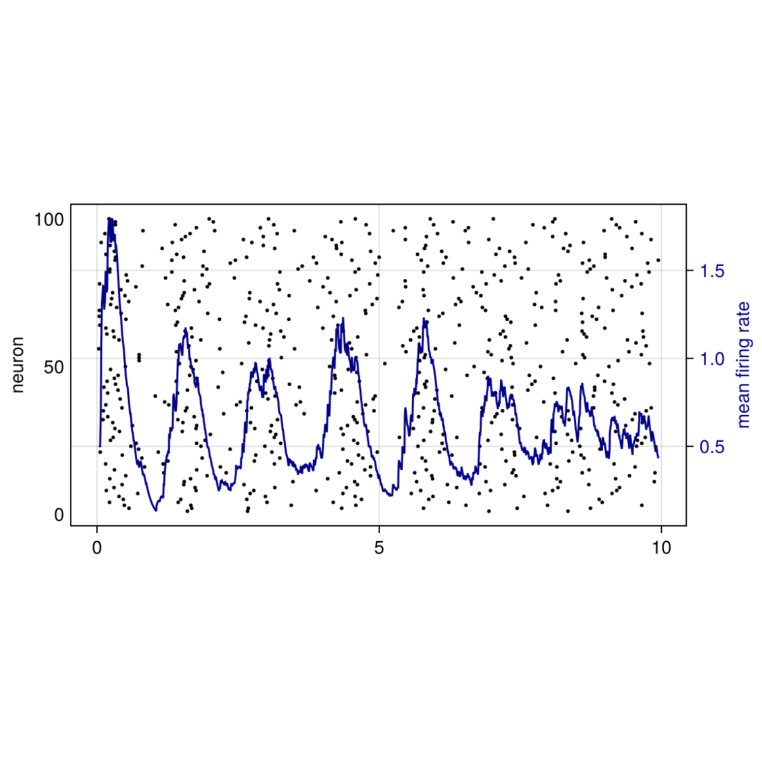
A functional law of large numbers (propagation of chaos) is proved for mean-field interacting age-dependent Hawkes processes. It gives theoretical foundation for the Refractory Density Equation.
@article{chevallier2017mean-field,author={Chevallier, Julien},doi={10.1016/j.spa.2017.02.012},journal={Stochastic Processes and their Applications},number={12},pages={3870-3912},publisher={Elsevier},title={{Mean-field limit of generalized Hawkes processes}},volume={127},year={2017},}
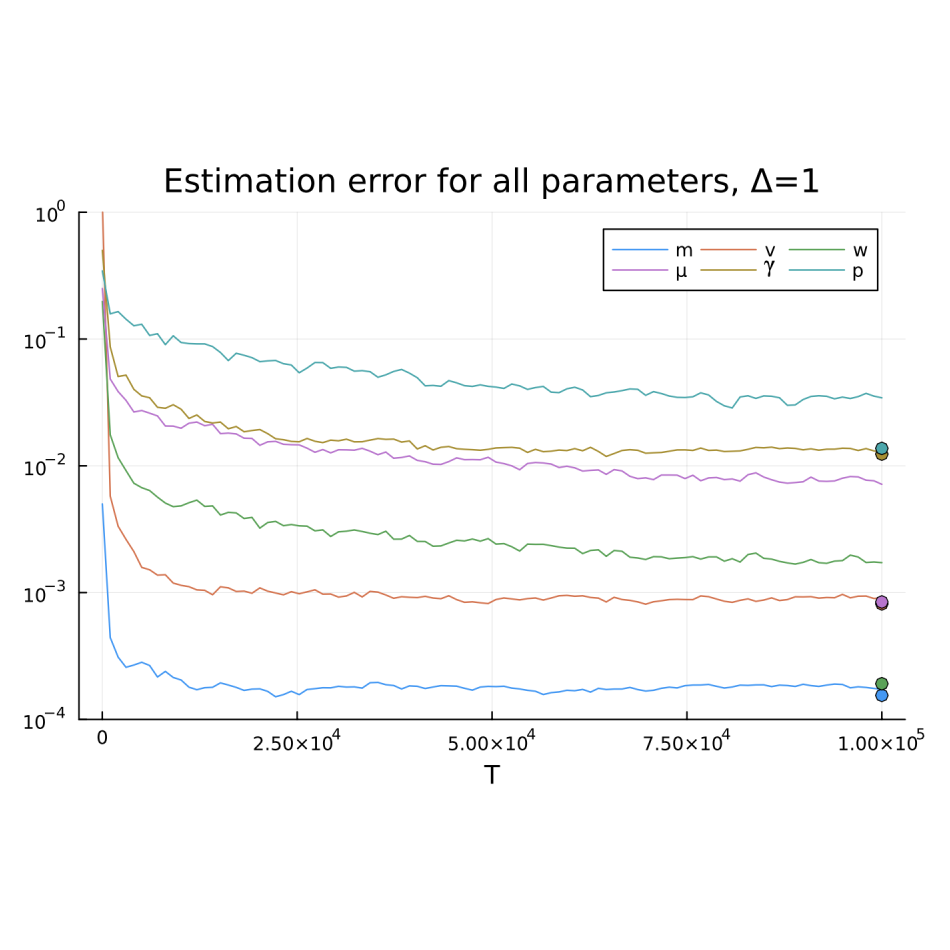
A huge number N of components are partitioned into two communities (excitatory and inhibitory). They are connected via a directed and weighted Erdös-Rényi random graph (DWER) with unknown parameter p. At each time unit, we observe the state of each component: either it sends some signal to its successors (in the directed graph) or remain silent otherwise. In this paper, we show that it is possible to infer the connectivity parameter p based only on the activity of the N components observed over T time units. We propose a simple algorithm for which the connectivity parameter p can be estimated with a specific rate which appears to be optimal in a simpler framework.
@article{chevallier2025inferring,author={Chevallier, Julien and L{\"o}cherbach, Eva and Ost, Guilherme},journal={Annals of Statistics (accepted)},title={Inferring the dependence graph density of binary graphical models in high dimension},year={2025},}
Habilitation Thesis
A journey in the fields of PDE, probabilities and statistics with point processes
This manuscript focuses on biological neural networks and their modelling. It lies in between three domains of mathematics - the study of partial differential equations (PDE), probabilities and statistics - and deals with their application to neuroscience. On the one hand, the bridges between two neural network models, involving two different scales, are highlighted. At a microscopic scale, the electrical activity of each neuron is described by a temporal point process. At a larger scale, an age structured system of PDE gives the global activity. There are two ways to derive the macroscopic model (PDE system) starting from the microscopic one: by studying the mean dynamics of one typical neuron or by investigating the dynamics of a mean-field network of n neurons when n goes to infinity.
@phdthesis{chevallier2025journey,author={Chevallier, Julien},month=dec,school={{Universit{\'e} Grenoble Alpes}},title={{A journey in the fields of PDE, probabilities and statistics with point processes}},type={HDR},year={2025},}